.png)
Graduation at Ayhay: Celebrating Growth, Readiness, and God’s Faithfulness


At Ayhay Christian School, Graduation is more than a ceremony. It is a joyful moment where we pause as a school community to recognize growth, give thanks to God, and celebrate children who are ready to move from one educational division to the next.
In many conventional school systems, especially in Madagascar, families often think of “graduation” when a child completes a major national examination level, such as CEPE, BEPC, or Baccalauréat. These are important academic milestones, and we respect their place in the national education system. However, at Ayhay, we also recognize another kind of milestone: the completion of a full educational division. Study more about our educational division here.
This means that when a child completes Preschool, Lower Elementary, Upper Elementary, or Erdkinder, the child graduates from that division and prepares to enter a new stage of learning.
Why Do We Celebrate Graduation at Ayhay?

We celebrate graduation because children grow in stages.
At Ayhay, our school structure is inspired by Montessori developmental principles. Montessori education recognizes that children pass through different planes of development, and that each stage has its own needs, strengths, and responsibilities. The American Montessori Society explains these developmental stages as 0-6, 6-12, 12-18, and 18-24 years, with Montessori programs often organized into three-year groupings such as 3-6, 6-9, 9-12, and 12-15.
This is why our school divisions are not random. They reflect important seasons in the child’s development:
Preschool is a season of independence, order, grace and courtesy, language, movement, and discovery.
Lower Elementary is a season of imagination, reasoning, responsibility, collaboration, and foundational academic growth.
Upper Elementary is a season of deeper research, moral reasoning, leadership, and stronger personal expression.
Erdkinder is a season of adolescence, purposeful work, service, identity, and preparation for the wider world.
So, when a child graduates from one division, we are not saying, “The child has finished learning.” We are saying, “The child has completed this stage and is ready for the next.”
Is Graduation Required in Montessori Schools?
It is important to clarify this: Dr. Maria Montessori did not create a rule saying that schools must hold a graduation ceremony.
Graduation ceremonies are not a required Montessori practice. However, Montessori education strongly values developmental transitions, the completion of a cycle, and the child’s readiness for the next environment. The three-year cycle is central to Montessori because children have time to begin as younger members, grow in confidence, and later become leaders and role models for younger classmates. Montessori Australia describes this three-year grouping as giving children the experience of being the youngest, then in the middle, then the oldest, while developing responsibility, peer learning, and a sense of belonging.

Behind our Graduation, we are creating a meaningful school moment that honors the child’s developmental journey.
Graduation Is Not Only About Academic Scores
Graduation is not about marks, exams, or performance on paper. At Ayhay, It is about the whole child progress.
We look at academic growth, but we also look at independence, responsibility, social maturity, spiritual formation, emotional development, work habits, leadership, and readiness for the next classroom environment.
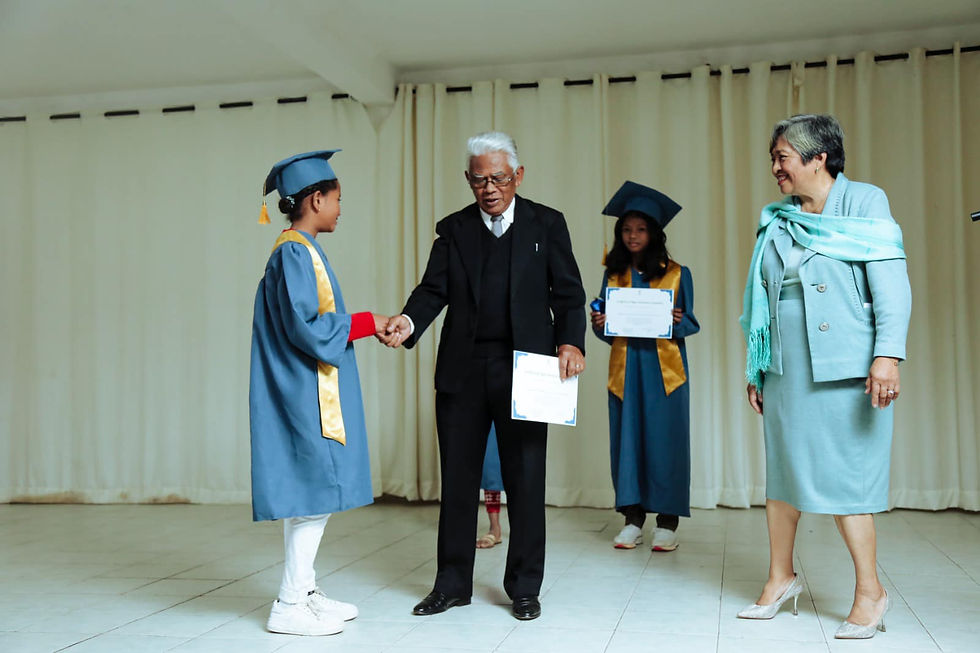
A child who graduates from Preschool, for example, has not simply learned letters and numbers. The child has learned to separate from parents with confidence, care for materials, interact with friends, follow routines, listen to stories, pray, sing, move, work with their hands, and begin to love learning.
A child who graduates from Lower Elementary has not simply completed lessons. The child has learned to ask questions, work with others, organize tasks, solve problems, and take more responsibility.
A child who graduates from Upper Elementary has grown in reflection, research, communication, independence, and leadership.
A child who graduates from Erdkinder has completed an important stage of adolescent formation and is ready to continue the journey with stronger identity, discipline, and purpose.
How Is This Different from Conventional Graduation?
In many conventional systems, graduation is often connected to official examinations or the end of a national cycle. In Madagascar, families commonly associate graduation with official examinations because these are major public examination points. The Ministry of Education refers to CEPE and BEPC and Baccalauréat as official examinations, which shows how strongly these levels are connected to national academic progression.
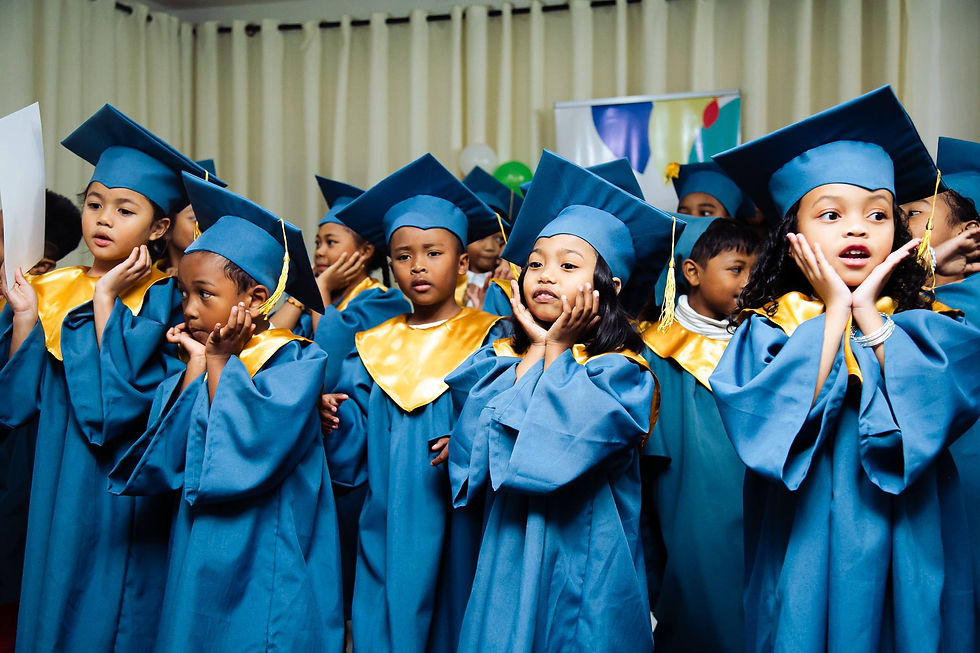
At Ayhay, we respect those national milestones. But our Montessori-inspired approach also helps us recognize smaller developmental milestones along the way. Growth happens throughout childhood. Each division completed is a real accomplishment.
How Do Other Countries Understand Graduation?
Graduation also looks different around the world.
In the United States, graduation is most commonly associated with the completion of high school, usually after Grade 12. However, many American schools also celebrate preschool graduation, kindergarten graduation, elementary promotion, middle school promotion, and high school graduation as different transition moments.
In the United Kingdom, the national curriculum is organized into “key stages.” Children move from Early Years to Key Stage 1, Key Stage 2, Key Stage 3, and Key Stage 4, with important assessments at the end of some stages. While the word “graduation” is not always used in the same way, the system clearly recognizes educational stages and transitions.
In Australia, graduation is strongly associated with the completion of senior secondary school, usually Year 12. Different states and territories award senior secondary certificates, such as the Higher School Certificate, Queensland Certificate of Education, South Australian Certificate of Education, or Western Australian Certificate of Education. At the same time, many Australian schools also celebrate transitions from preschool, primary school, and middle years.

So, around the world, graduation can mean different things depending on the system. What matters is that the school community understands what the ceremony represents.
At Ayhay, graduation means: “This child has completed an educational division and is ready for the next stage.”
A Christian Celebration of Growth
As a Christian school, Graduation Day is also a moment of thanksgiving.
We believe children are gifts from God. Their growth is not only the result of schoolwork, but also of God’s grace, family support, teacher guidance, and the child’s own effort. Graduation gives us time to thank God for what He has done in each child’s life.

It is also a moment to bless the children as they move forward. We pray that they will continue to grow in wisdom, character, faith, knowledge, courage, and love.
A Message to Parents
Dear parents, when your child graduates at Ayhay, please understand that this is not just a performance or a photo opportunity. It is a marker of growth.
Your child has spent years learning, trying, practicing, making mistakes, growing stronger, and becoming more ready. Graduation allows the school, the family, and the child to say together: “We see your growth. We are proud of you. We are ready to walk with you into the next stage.”
This is why Graduation Day matters.
It teaches children that growth should be recognized. It teaches them that effort has meaning. It teaches them that moving forward is something to celebrate with humility and gratitude.
Graduation is a celebration of completion
Graduation at Ayhay Christian School is a celebration of completion, transition, readiness, and thanksgiving.
A child graduates when they complete an educational division: Preschool, Lower Elementary, Upper Elementary, or Erdkinder.
We celebrate because every stage of childhood matters.
We celebrate because each child is growing.
We celebrate because God is faithful.
And we celebrate because the journey of learning continues.
References
Ayhay Christian School. Family Handbook 2025.1.0 and curriculum documents for Early Childhood, Lower Elementary, Upper Elementary, and Erdkinder. Internal documents.
American Montessori Society. “Planes of Development and Sensitive Periods,” Parts 1–3.
Montessori Australia. “What Is the Importance of Three-Year Age Grouping?” and “Multi-Age Groupings.”
Ministère de l’Éducation Nationale, Madagascar. “Examens officiels CEPE et BEPC.”
GOV.UK. “The National Curriculum: Overview.”
National Center for Education Statistics, United States. “High School Graduation Rates.”
Australasian Curriculum, Assessment and Certification Authorities. “Senior Secondary Certificates.”
South Australian Certificate of Education. “An Australian Curriculum” and “What Is the SACE?”


Comments